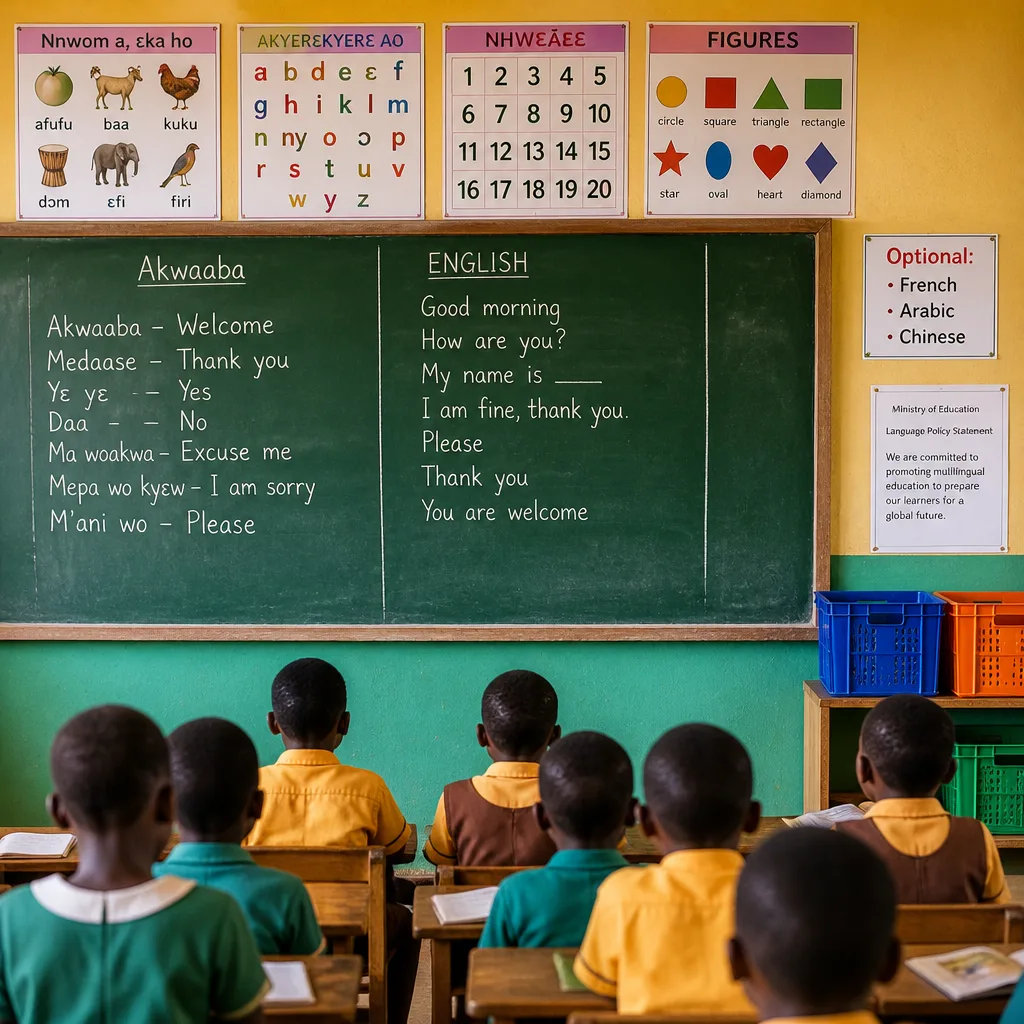
The Ministry of Education has issued a formal clarification of the government's proposed language of instruction policy for basic schools, saying Ghanaian languages will remain central in the early years and that foreign languages such as French, Arabic and Chinese will not be mandatory.
What the ministry has confirmed
In a statement released on 2 August, the ministry's press secretary, Hashmin Mohammed, addressed public confusion about the revised curriculum. The ministry set out a phased approach to the medium of instruction intended to strengthen early literacy and help pupils transition smoothly into higher grades.
- Kindergarten to Primary 3: instruction in Ghanaian languages as the primary medium.
- Primary 4 to Primary 6: bilingual instruction in Ghanaian languages and English.
- Foreign languages (e.g. French, Arabic, Chinese): optional subjects, not compulsory; availability dependent on schools having qualified staff and resources.
“From Primary Four to Primary Six, both Ghanaian languages and English will be used as the medium of instruction. This bilingual approach is designed to support a smooth transition to higher levels of education, where English assumes a greater role, while preserving learners’ competence in Ghanaian languages. The Ministry further clarifies that foreign languages such as French, Arabic, and Chinese among others are not compulsory subjects. They will be offered as optional languages for pupils who wish to acquire additional language skills, subject to the availability of qualified teachers and learning resources in their respective schools.”
Why this matters for parents and schools
The clarification addresses two common concerns: whether children will be denied early access to English, and whether foreign languages will be imposed on pupils. The ministry emphasises that the approach is designed to build strong foundations in literacy, numeracy and critical thinking by using languages children understand best in their formative years.
Practical implications include:
- Parents should expect teaching in a Ghanaian language up to Primary 3, with greater use of English introduced from Primary 4.
- Schools will offer foreign language options only where they have the necessary teachers and materials; uptake may therefore vary between schools and districts.
- The policy aims to preserve competence in indigenous languages while preparing learners for English-medium instruction at higher levels.
Policy summary at a glance
| School stage | Medium of instruction |
|---|---|
| Kindergarten – Primary 3 | Ghanaian languages (primary medium) |
| Primary 4 – Primary 6 | Ghanaian languages and English (bilingual) |
| Foreign languages | Optional; subject to teacher availability and resources |
The ministry has urged schools, parents and other stakeholders to refer to its official statement for the full details and to contact local education authorities if they have questions about how the provisions will be implemented in their area. For families, the key takeaway is that the revised policy seeks to prioritise foundational learning in languages pupils know best, while keeping additional language learning voluntary and resource-dependent.