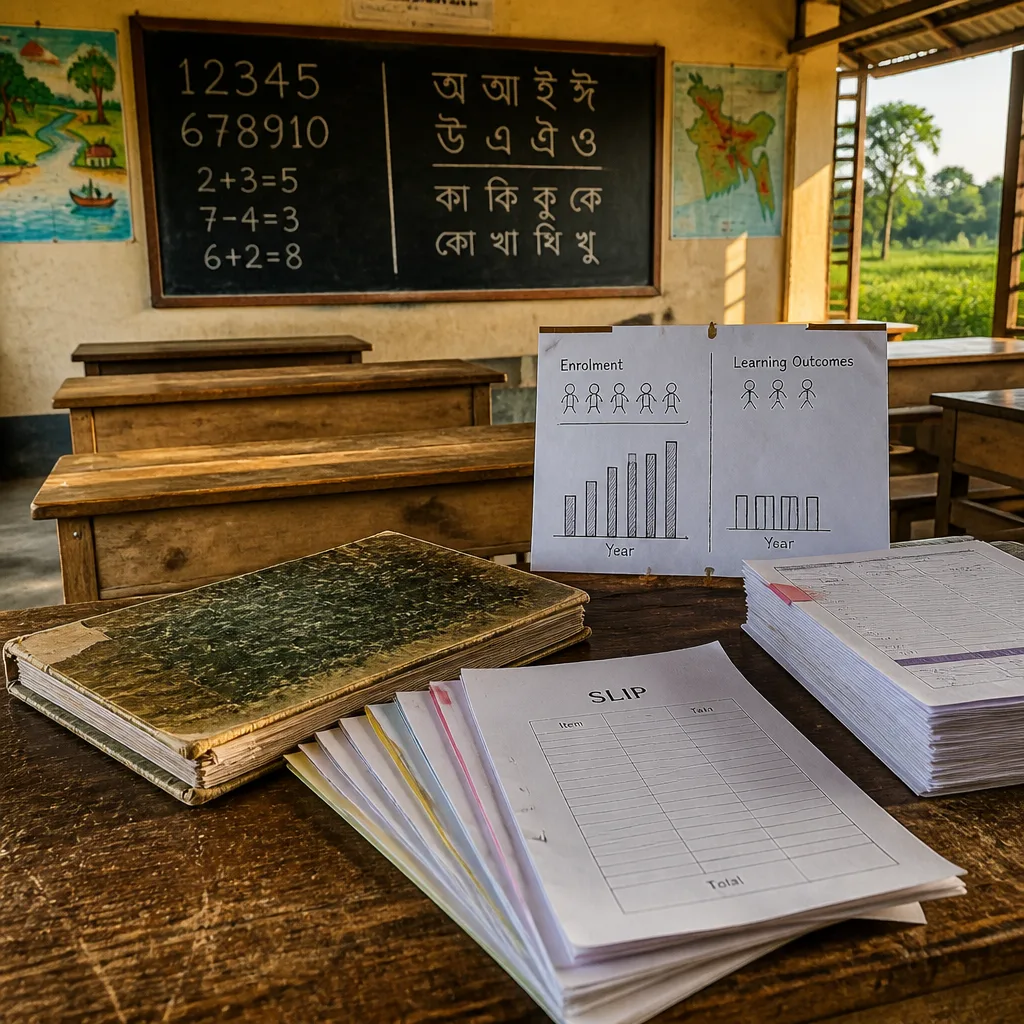
Bangladesh achieved near-universal primary enrolment and closed the gender gap in classrooms over the last three decades, yet concerns persist about what children actually learn at school. A new policy brief from the Power and Participation Research Centre (PPRC), drawing on a 2025–26 study supported by UNICEF and the Directorate of Primary Education (DPE), scrutinises one of the country’s key decentralised reforms: the School Level Improvement Plan (SLIP).
What SLIP was meant to do
Introduced as part of the third Primary Education Development Programme (PEDP3), SLIP was designed to give headteachers, School Management Committees (SMCs) and communities a small but meaningful degree of financial discretion. The intention was to close the gap between school attendance and actual learning by allowing individual schools to set priorities and allocate resources where they were most needed.
What the new study examined
The PPRC brief presents an evaluation based on the 2025–26 SLIP Effectiveness Study. The research covered 100 schools across 42 upazilas in all eight divisions of the country and triangulated evidence from over 3,500 interviews, focus groups and surveys. The brief frames its findings against the broader worry — voiced by parents in both rural and hill areas — that pupils cannot reliably read a short Bangla paragraph by the end of Year 3 or perform basic two‑digit subtraction, despite near‑universal enrolment.
Key findings and the learning gap
The study places SLIP in the context of a well‑documented regional problem often described by development economists as the "schooling versus learning" gap. International metrics such as the World Bank’s Learning Poverty and household assessments like ASER show similar patterns across South Asia: access has improved more rapidly than learning outcomes.
- Policy instrument assessed: SLIP, a mechanism for devolved, school‑level spending under PEDP3.
- Scale of review: 100 schools, 42 upazilas, all eight divisions; 3,500+ interviews and survey responses.
- Supporters of the study: PPRC, UNICEF and DPE.
Implications for policy and practice
The brief is framed as an independent assessment of whether giving schools financial autonomy has translated into better learning. While the country’s achievement in expanding enrolment is widely recognised, the research underlines the continuing challenge of ensuring that school attendance equates to improved literacy and numeracy. For policy‑makers and donors, the study offers granular evidence to inform whether decentralised funds, accompanied by capacity building and accountability at community level, are sufficient to shift classroom practice.
What parents and educators should watch next
Parents, headteachers and local education authorities will want to follow how the DPE and development partners respond to the brief’s analysis. Key questions include whether SLIP allocations will be adjusted, how SMCs’ roles might be strengthened, and what monitoring measures will be introduced to link expenditure decisions explicitly to measurable learning gains.
| Aspect | Detail |
|---|---|
| Study period | 2025–26 |
| Schools reviewed | 100 |
| Upazilas included | 42 (all 8 divisions) |
| Evidence gathered | 3,500+ interviews, focus groups and surveys |
The PPRC brief adds to a growing body of evidence that expanding access is only one step. The next policy challenge is to translate school‑level discretion into sustained improvements in learning — a task that will require clear accountability, teacher support and tracking of outcomes alongside continued investment.