West Lothian councillors have been urged to focus on early engagement with tenants after housing officers warned that forced access is not a realistic or lawful option to resolve the problem of badly damaged council homes.
Scale of the voids problem
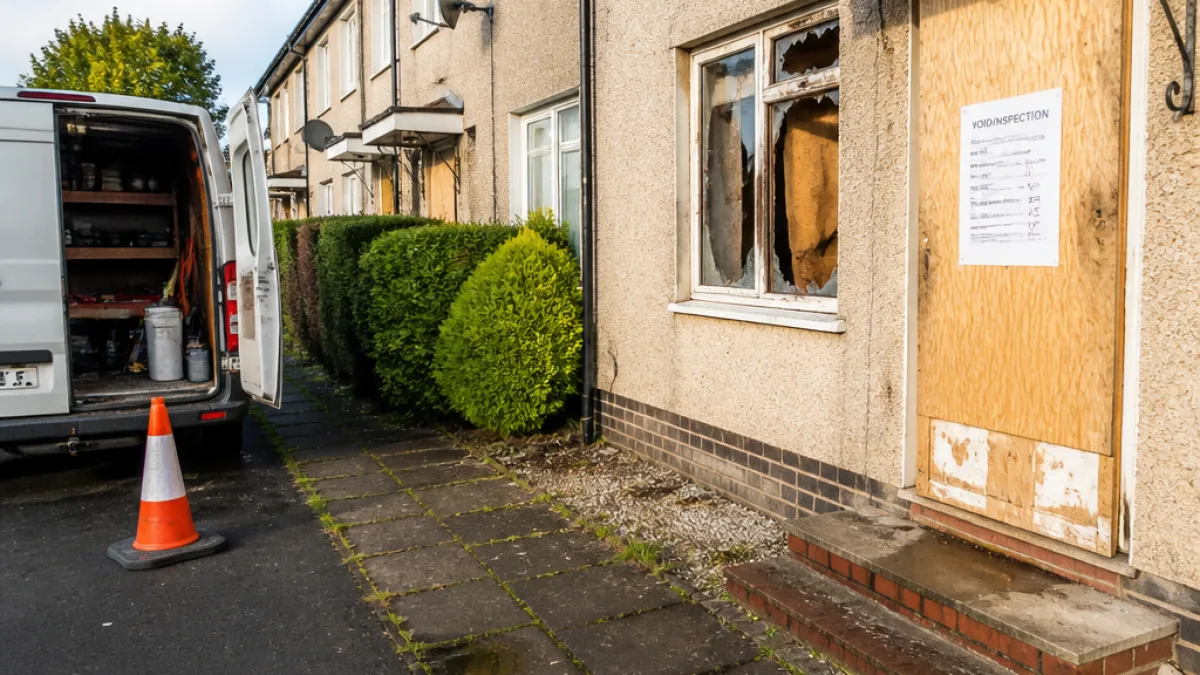
A report to the Housing Services Policy Development and Scrutiny Panel (PDSP) sets out the complexity behind properties becoming empty and the length of time taken to return some to a lettable standard. During the last financial year, 609 properties from the council’s lettable stock became void. Officers said a large proportion of those returned were in the worst condition — Category C — requiring in excess of £12,000 each to make them ready for re-letting.
Officers told councillors there are no simple or immediate fixes. In roughly half of tenancy terminations, staff do not carry out a planned or effective pre-termination visit because the council receives no formal notification of the tenancy ending. The report highlights several common circumstances:
- Tenant deceased — 158 homes became void for this reason in 2025/26.
- Vacated without contacting housing staff — 177 homes.
- Tenant abandonment — 53 homes.
- Evictions — 45 homes.
- Moved into care or supported accommodation — 49 homes.
- Imprisonment — 7 homes.
Early engagement and practical limits
The report stresses that where tenants do engage, outcomes are markedly better: only 120 of the properties vacated in the year — around 20% — followed a pre-termination visit by a housing officer. Officers said that even when notice is given, access may not be provided for the necessary checks and property clearance.
“A property does not usually become a difficult void because of one single issue. In many cases, poor void conditions are the result of cumulative and complex factors which have developed over time.”
That passage, included by officers in their briefing to councillors, underlines the multi-faceted causes of poor void conditions and the difficulty of attributing blame to a single factor.
Operational implications and resources
The scale and cost of Category C repairs mean the council faces both a financial burden and a delay in returning homes to the waiting list. The briefing does not offer quick remedies but signals that preventing poor voids depends on keeping in contact with tenants and improving intelligence about likely terminations.
| Metric | 2025/26 figure |
|---|---|
| Total lettable properties becoming void | 609 |
| Voids after pre-termination visit | 120 (20%) |
| Category C: worst condition (repairs ~£12,000+) | Not separately quantified in report |
What this means for tenants and the local housing supply
For prospective tenants on waiting lists, the findings explain part of the delay in allocations: a significant number of council homes require costly work before they can be re-let. For existing tenants and their families, the council’s emphasis on early and continuing engagement is a reminder that formal notification of tenancy endings — and cooperation with pre-termination visits — materially affects how quickly a property can be processed.
Councillors will consider the report’s findings alongside longer-term housing and tenancy management strategies. Officers make clear that tackling the problem will require a mixture of better communication with occupants, targeted intervention where tenants are vulnerable, and realistic expectations about what can be achieved without infringing legal protections.
Further decisions on any changes to practice or resource allocation will be taken through the council’s usual committee process.