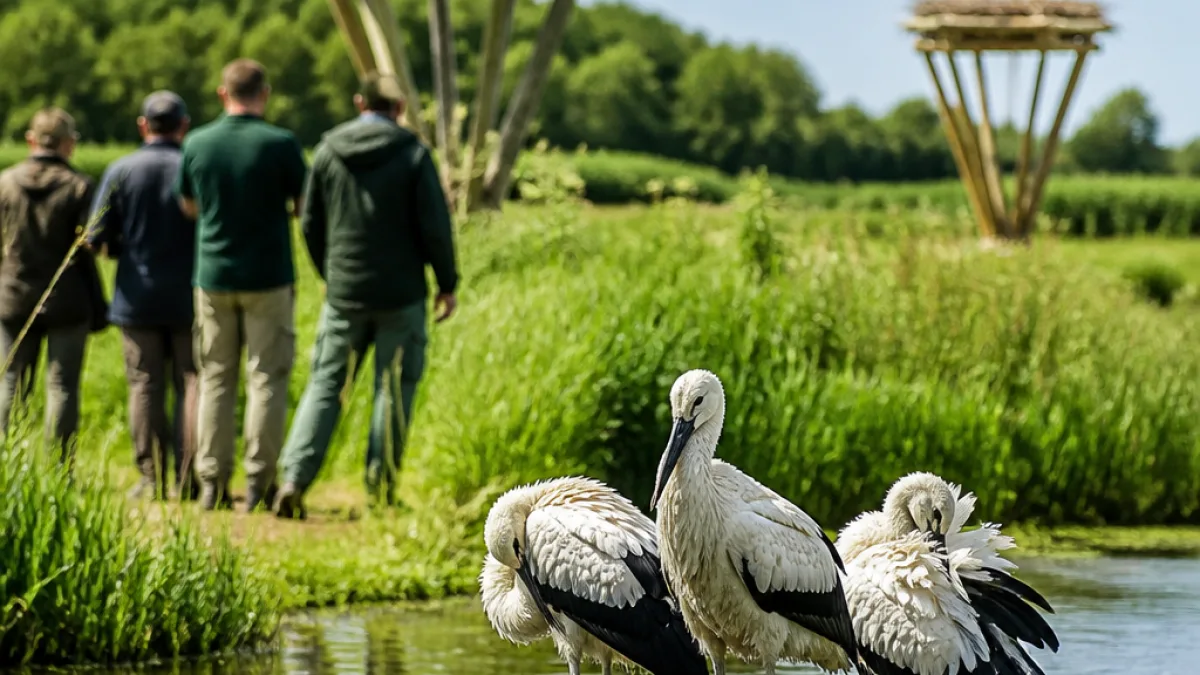
A trio of juvenile white storks has been released at Willington Wetlands in Derbyshire as part of an effort to restore a species absent from the Midlands since the Middle Ages. The birds — two of known sex and one of as-yet undetermined sex — were settled into the reserve this week and have begun to explore their new surroundings.
A deliberate reintroduction to encourage wild visitors
Derbyshire Wildlife Trust, which manages the wetland site, says the young storks are intended to function as a so-called “magnet flock”: the presence of resident birds can persuade migrating individuals to settle and, crucially, to attempt to breed locally. Records show white storks disappeared from the region around the 14th century, largely due to habitat loss and hunting, and while recent flyovers have been noted in places such as Matlock and Ashbourne, none have yet established nests in the county.
“It feels absolutely incredible… Our next aim is to get to the point where they’re a sustainable population and they can live outside, flying around and people can see them moving through the landscape.”
The remark above was made by Katie Last, the living landscape officer for Derbyshire Wildlife Trust, who has overseen the scheme and manages the reserve. The trust has invested years in restoring habitat at Willington, creating the mix of wetlands, grassland and nest sites thought to be needed for storks to thrive.
Practical steps and local context
To increase the chances the birds will stay and breed, conservationists plan to install artificial nesting platforms in existing trees and maintain favourable wetland conditions. The trust emphasises that white storks are social birds that prefer safety in numbers, hence the strategy of introducing multiple juveniles together.
- Number released: three juvenile white storks (one male, one female, one undetermined)
- Release site: Willington Wetlands, Derbyshire
- Objective: attract migrating wild storks and establish a sustainable local breeding population
The project follows comparable reintroduction and settlement efforts elsewhere in England, where small groups of storks and managed habitats have helped create local colonies. Derbyshire Wildlife Trust says it will continue monitoring and managing the site to give the birds the best possible chance of integration with wild migrants passing through the Trent Valley.
| Issue | Status |
|---|---|
| Historic absence in county | Since about 14th century |
| Recent wild records nearby | Matlock and Ashbourne sightings recorded |
| Local management | Derbyshire Wildlife Trust overseeing project |
For local residents and visitors, the release will be of interest both as a conservation milestone and as a potential new attraction for wildlife watchers. The trust has urged people to respect the reserve and avoid disturbing the birds, particularly during the sensitive first weeks after release while they acclimatise.
Staff will continue to report on the birds’ progress and any evidence of wild storks choosing to join them in the seasons ahead.