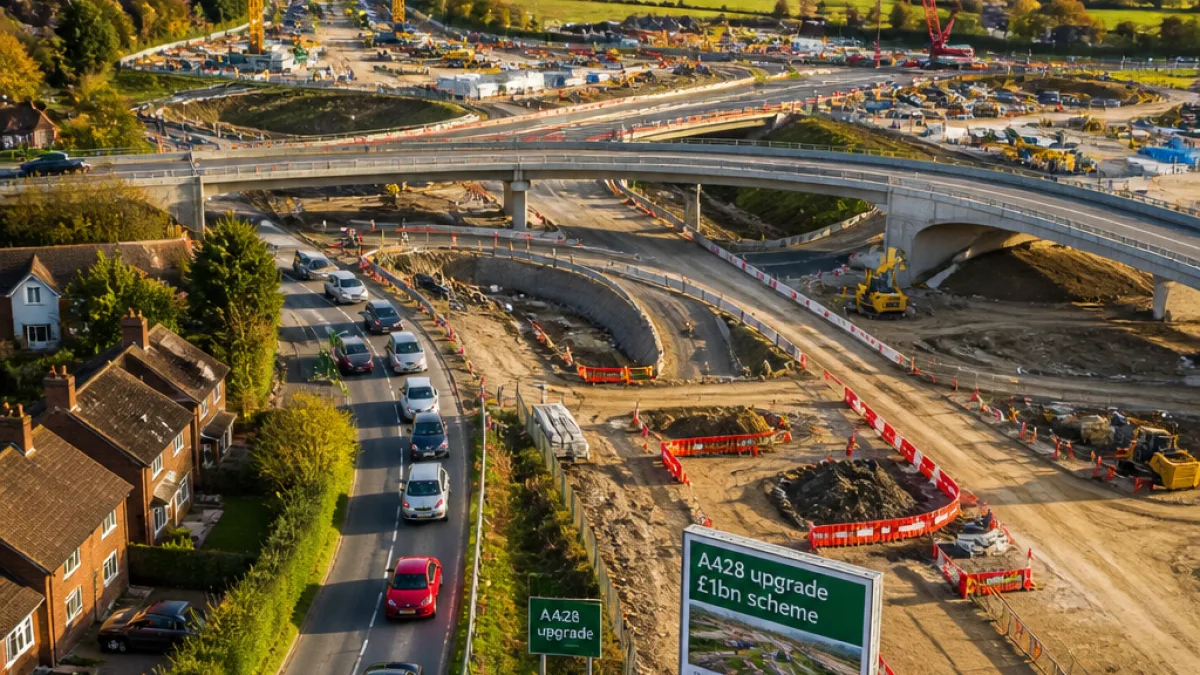
The £1 billion scheme to upgrade the final single-carriageway stretch of the A428 between the Black Cat roundabout and Caxton Gibbet has divided opinion among residents close to the works.
What the project will deliver
National Highways is building a new 10-mile dual carriageway intended to improve the strategic route linking the M1 near Milton Keynes to east coast freight ports such as Harwich and Felixstowe. The project includes rebuilding the Caxton Gibbet roundabout as a two‑level junction, connecting the new A421 dual carriageway with the A428 and A1198. Traffic on the new dual carriageway will pass over the junction using a flyover bridge.
| Element | Detail |
|---|---|
| Estimated cost | £1 billion |
| Length of new dual carriageway | 10 miles |
| Projected journey time saving | Around 10 minutes at peak times (National Highways) |
| Expected opening | Spring 2027 |
Local views — improvement versus cost
Work is under way close to villages such as Caxton and Papworth Everard. Some residents say the scheme will relieve long‑standing congestion at key junctions. Others accept the practical benefits but question whether the reduction in journey times justifies the scale of expenditure.
"Caxton roundabout has always been a source of traffic jams... I think it will be a big improvement," said Charles Gentry, who lives in Caxton.
Mr Gentry, 42, also expressed reservations about the cost, noting it was "a lot" and that with increasing home working it is hard to be certain the saving of around 10 minutes will be widely realised. Another local, who did not wish to be named, told reporters they believed the money could be spent on priorities other than major roadbuilding.
Why the scheme matters
The A428 forms part of a strategic east‑west corridor used by commuter traffic and freight heading to the east coast ports. Proponents argue that replacing the remaining single carriageway will reduce delays, improve journey time reliability and support economic flows across the region. National Highways’ estimate of a typical peak time saving is around 10 minutes per trip once the works are complete.
- Relief for congestion: Replacing single carriageway with dual carriageway aims to reduce queues at choke points such as Caxton Gibbet.
- Freight and connectivity: The route is an important link between the M1 and east coast ports.
- Local disruption during construction: Residents have reported queues and traffic impacts while works continue.
National Highways says the scheme is scheduled to open to traffic from spring 2027. For residents and businesses around Caxton, the coming months will be the most disruptive, but completion is expected to change traffic patterns along this busy corridor.
Questions about value for money are likely to persist while costs remain high nationally and household budgets are under pressure. The trade‑off between short‑term disruption and long‑term transport benefits will remain central to local debate as the project moves towards opening.