Major investment follows watchdog’s criticism
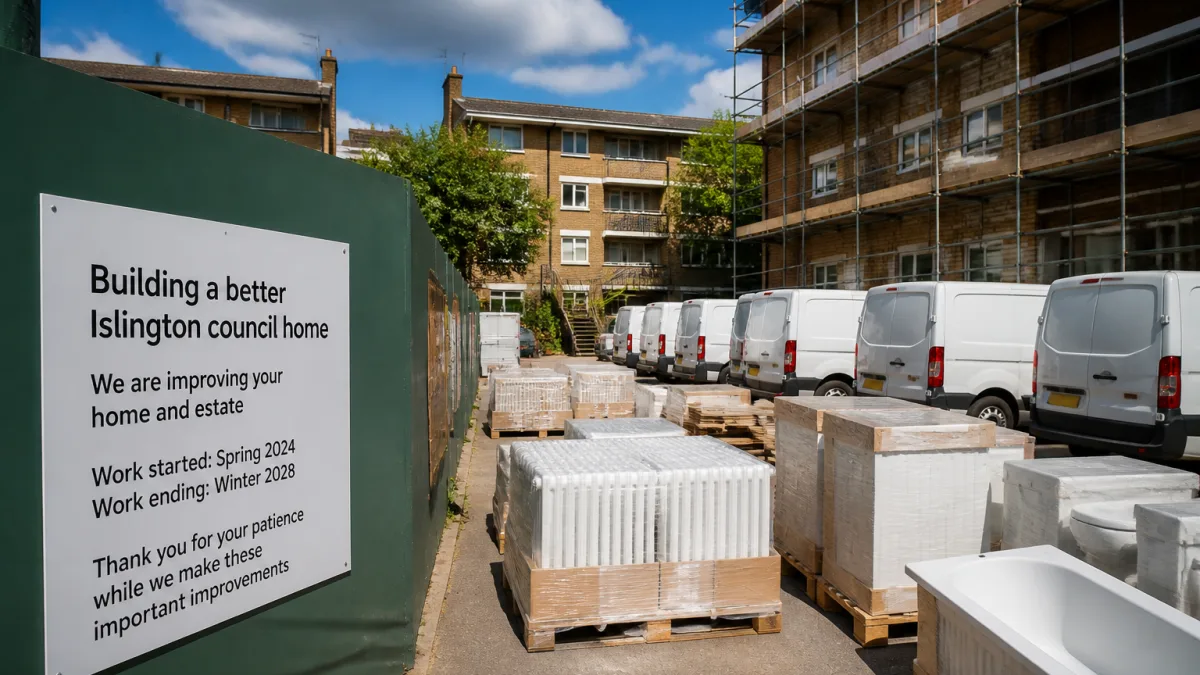
Islington Council has committed £390m to upgrade thousands of homes in its housing portfolio, two months after the Regulator of Social Housing (RSH) identified what it described as “serious failings” at the authority. The council says the programme will run over the next five years and focus on large-scale improvements to tenants’ heating, kitchens and bathrooms.
“serious failings”
The move represents one of the largest recent commitments to council housing works locally. While full delivery details have not been published, the scale and timescale outlined indicate a phased approach across estates and street properties to address long-standing repair and component renewal needs. The council has not yet publicly set out which blocks or streets will be prioritised first.
What the works will cover
According to the council’s outline, the programme will concentrate on core components which have the biggest impact on day-to-day living conditions. In practice, that means replacing outdated heating systems, renewing kitchens and refurbishing bathrooms where required. These are typically high-volume works that can be delivered in batches, and they are often sequenced to minimise disruption for residents.
| Area of work | Planned focus | Timeframe |
|---|---|---|
| Heating | Upgrades to systems for reliability and efficiency | Within five years |
| Kitchens | Renewals where components have reached end of life | Within five years |
| Bathrooms | Refurbishment and replacements as needed | Within five years |
In many social housing programmes, component renewals are bundled to reduce costs and contractor call-outs. Although procurement details have not been confirmed, residents should expect the council to notify blocks well ahead of works starting, including access arrangements, hours of work and what to do if a home needs special consideration.
Why this matters for tenants
The RSH’s involvement underscores the seriousness of recent performance concerns. The regulator’s finding of “serious failings” is a clear signal that standards required attention. This funding package is designed to accelerate improvements in areas that most directly affect health, comfort and safety in the home. Replacement of older heating systems can reduce breakdowns and cut running costs for households, while modern kitchens and bathrooms typically bring properties back up to contemporary standards of function and hygiene.
Residents often ask whether major works mean decanting. For kitchen, bathroom and heating renewals, most properties can remain occupied, although there may be short periods when water or power is turned off to complete installations. The council will need to set out how it will support vulnerable tenants through any disruption and how it will coordinate with leaseholders where blocks are mixed-tenure.
Oversight, sequencing and what comes next
Islington has not yet published a detailed delivery timetable or estate-by-estate schedule. Ordinarily, programmes of this size are rolled out in phases, informed by stock condition data and safety assessments. Residents should look out for formal notices, consultation letters and engagement events offering more clarity on when their homes are due for works and what options exist if proposed dates are unsuitable.
- Scale: Thousands of homes across the council’s portfolio.
- Budget: £390m allocated over five years.
- Focus: Heating systems, kitchens, bathrooms.
Funding of this magnitude will also require robust monitoring. The council will be expected to track delivery, quality, tenant satisfaction and value for money, and to report transparently on progress as properties are upgraded. Further information is likely to follow as contracts are let and the first phases are scheduled.
For now, the headline is clear: a significant investment is being directed at essential home components across Islington’s housing stock, shaped by a regulator’s stark warning and aimed at raising living standards for tenants over the medium term.