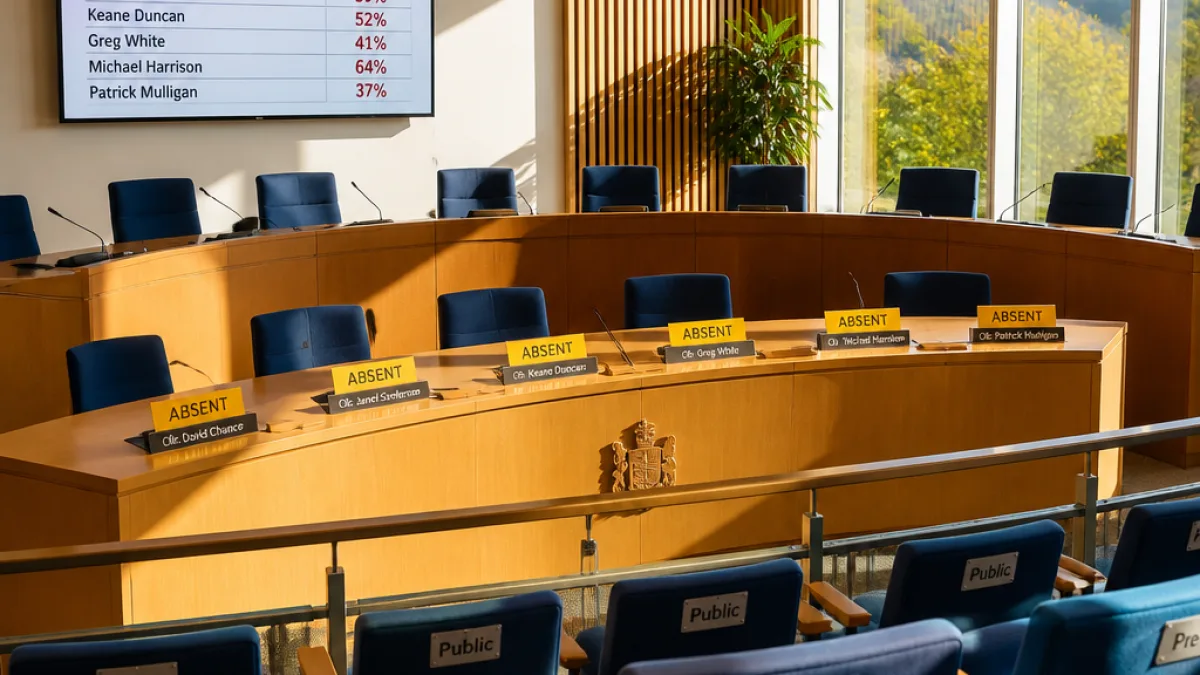
North Yorkshire Council will not seek repayment of allowances from six members whose attendance at appointed committee meetings dipped below the council’s expected level during 2025/26, officers have confirmed.
Attendance threshold and process
Under the council’s arrangements, councillors are expected to attend at least 66 per cent of meetings to which they are appointed. When attendance falls beneath that level, officers contact the member to discuss the circumstances, remind them of their responsibilities and assess whether additional support is needed.
"Where a councillor’s attendance at the committees they have been appointed to falls below 66 per cent in a year, they are contacted to remind them of the importance of attending meetings and to determine whether there are any circumstances that explain their lower than expected attendance and if they are in need of any additional support."
The council said it had accepted the explanations offered by the six councillors and therefore no deduction from the flat basic allowance will be pursued.
Councillors affected and those with full attendance
The six councillors whose attendance did not meet the guideline in 2025/26 are:
- Angus Thompson (Conservative), North Richmondshire
- Dan Sladden (Liberal Democrat), Sowerby and Topcliffe
- John Cattanach (Independent — North Yorkshire Independent group), Cawood and Escrick
- John Mann (Reform UK), Oatlands and Pannal
- Lindsay Burr (Independent — North Yorkshire Independent group), Malton
- Nathan Hull (Conservative), Washburn and Birstwith
By contrast, four councillors attended all of their committee meetings over the 12 months: leader Carl Les (Catterick Village and Brompton-on-Swale division), David Staveley (Settle and Penyghent), George Jabbour (Helmsley and Sinnington) and Roberta Swiers (Cayton).
| Allowance | Amount |
|---|---|
| Flat basic allowance for every councillor | £17,964 per year |
Local consequences and scrutiny
All councillors receive a uniform basic payment, with additional sums paid for extra duties such as committee chairs. The council’s decision to accept explanations rather than reclaim money highlights the balance it strikes between enforcement of attendance standards and recognition of legitimate reasons for absence.
Officers say members were contacted only where they had not already notified the council that they would be unable to fulfil commitments — for example because of a planned medical procedure. The approach is intended to ensure absences are understood and, where necessary, support is provided.
However, the outcome is likely to prompt interest from residents wanting assurance that decision-makers are engaging consistently with their responsibilities. Questions may follow about how the council monitors attendance, what support is offered to members with genuine obstacles, and whether the 66 per cent benchmark remains an effective safeguard for democratic accountability.
For now, payments stand as they are. Any councillor who takes on extra responsibilities continues to be eligible for corresponding additional allowances as set out by the council.