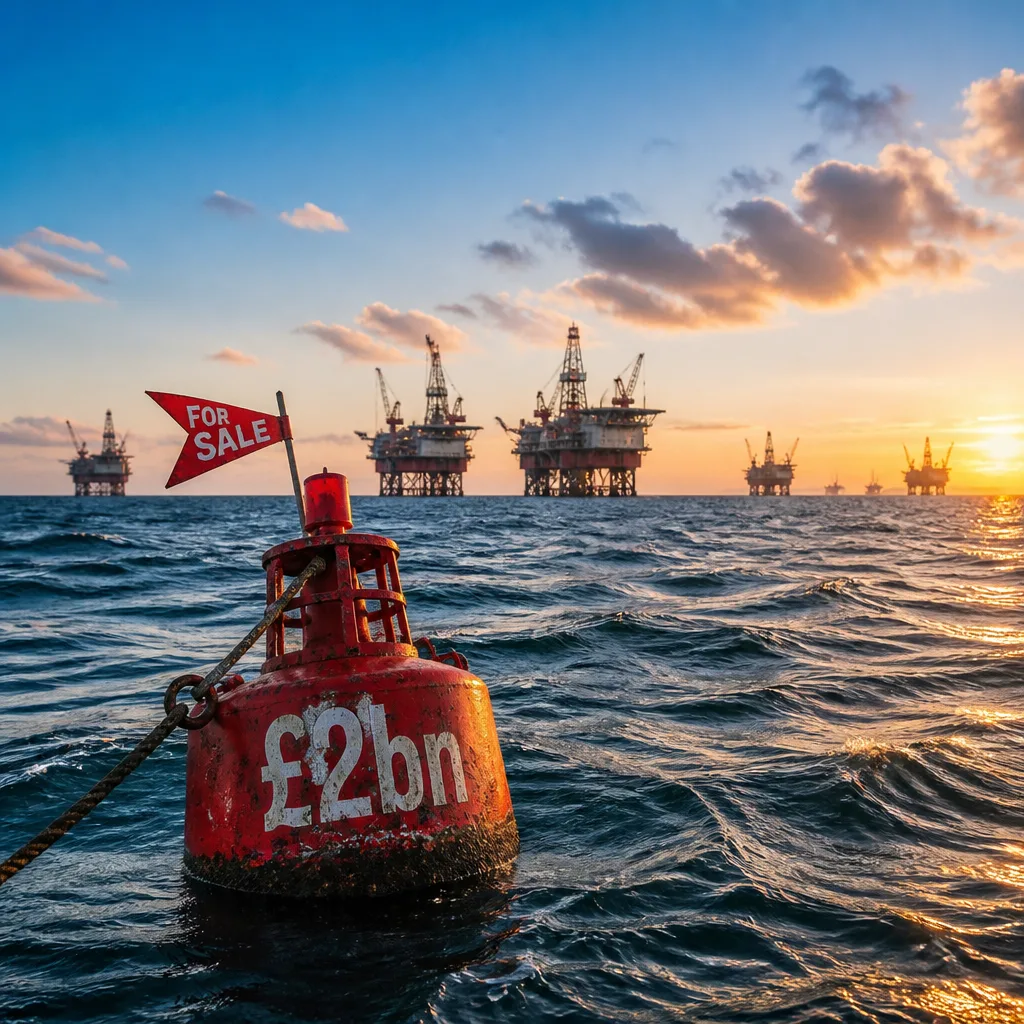
BP has put its North Sea oil and gas business up for sale, a decision that would close a 60-year chapter of production in the region and reconfigure the group’s UK footprint.
Assets, scale and rationale
The division on offer includes five production hubs — two in the central North Sea and three to the west of Shetland — and directly employs about 1,100 people. In 2025 the business produced 117,000 barrels of oil equivalent per day, compared with BP’s total output of 2.3 million barrels per day.
BP said the move follows a review designed to slim the group and focus capital on higher-value opportunities. The company indicated a sale could realise around £2bn.
Leadership comment
“As we focus our portfolio and direct capital to our highest-value opportunities, we believe our North Sea business will be better positioned as part of another company,”
Chief executive Meg O’Neill, who took charge in April, described the assets as having “world-class people, resilient assets and a proud heritage,” and said BP would seek an outcome that “recognises that value.” She also emphasised BP’s continued connection to the UK: the group employs around 13,960 people in the country and its global headquarters will remain in the UK.
Context and recent negotiations
Financial press reports last month said BP had held talks with Ithaca Energy about a possible sale at roughly the same price, but those discussions did not result in a deal. BP has stated it will continue to operate the business safely and reliably while the sale process runs.
| Item | Figure |
|---|---|
| 2025 production (North Sea business) | 117,000 boe/d |
| BP group production (2025) | 2.3 million boe/d |
| Employees in North Sea unit | ~1,100 |
| BP employees in UK | ~13,960 |
| Estimated sale proceeds | £2bn |
Political backdrop
The announcement arrives amid ongoing political debate over the future of North Sea drilling. Labour’s 2024 manifesto pledged not to issue new licences while honouring existing ones. Separately, the Prime Minister, Andy Burnham, recently told US President Donald Trump he would adopt a "pragmatic approach" to North Sea oil and gas, saying “there is a resource there” and noting the pressures facing households.
Potential consequences for households and businesses
- Sale proceeds could strengthen BP’s balance sheet and redirect investment towards higher-return projects; that may influence future energy investment in the UK.
- For local communities and suppliers, transfer of ownership could mean different contracting strategies, potential reorganisation and a change in capital spending.
- On energy security, operatorship changes rarely alter immediate production, but long-term maintenance, decommissioning plans and investment decisions will determine how the fields contribute to UK supply.
BP underlined it will continue to operate the assets safely during the sale. The company framed the disposal as part of a portfolio focus under new leadership while reiterating a long-term commitment to the UK, including keeping its global headquarters in the country.
How swiftly a buyer emerges, and whether the transaction preserves jobs and investment levels, will be watched closely by industry, local economies and government as the sector navigates commercial, environmental and political pressures.