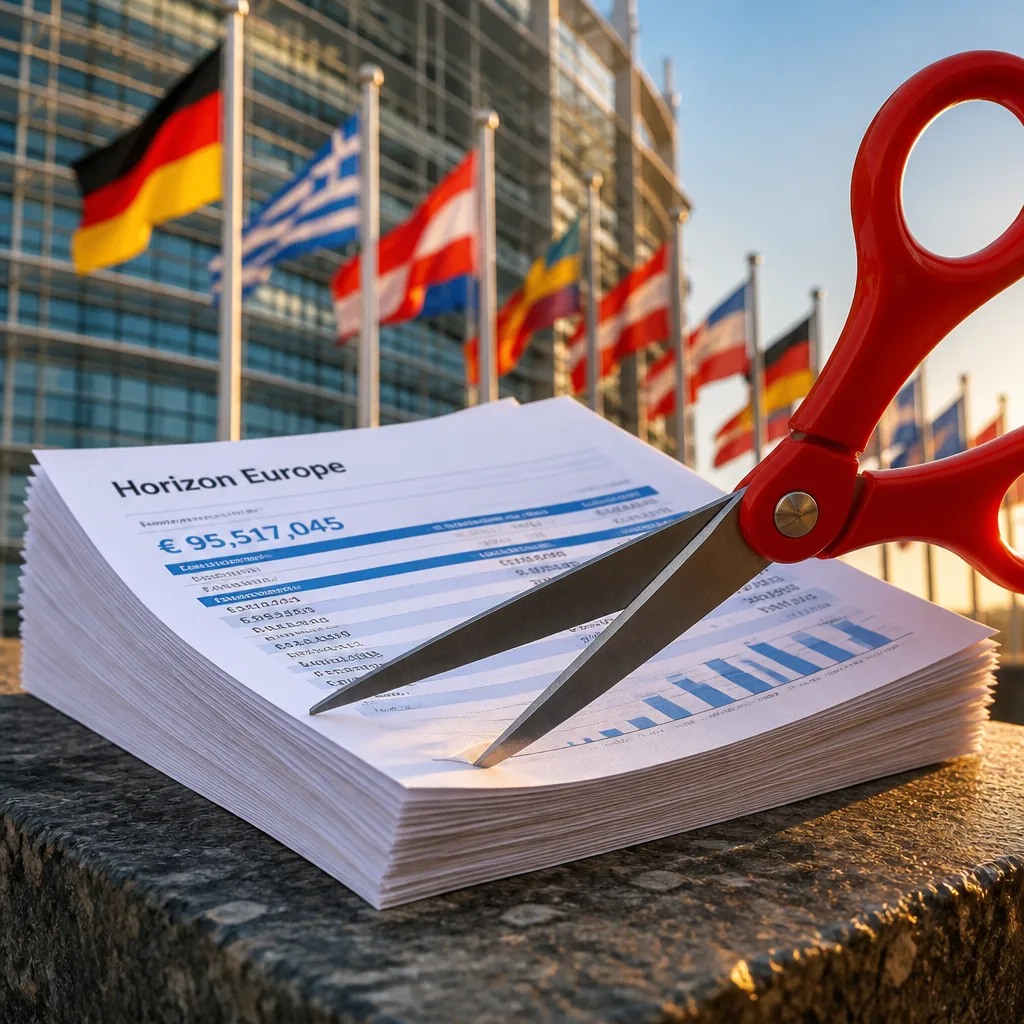
German Chancellor Friedrich Merz has called for reductions amounting to “several hundred billion euros” to the European Commission’s draft multiannual budget for 2028–34, warning that increases proposed across the bloc should be rolled back. The intervention, made during a visit to Dublin on 28 July, raises immediate questions about the future size of the EU’s flagship research and innovation fund, Horizon Europe.
What the numbers show
Last year the Commission tabled a near-€2 trillion proposal in current prices for the 2028–34 period — equivalent to about €1.76 trillion in 2025 prices after inflation adjustments. In June, the Cypriot Council presidency released negotiation figures suggesting an overall envelope of €1.73 trillion, a cut of almost 2% from the Commission’s original ask. Those Council figures already include a reduction to Horizon Europe from €154.9bn to €148.6bn (a 4% cut).
At the same time, Members of the European Parliament’s budget committee have proposed a substantially larger allocation for Horizon Europe — about €177bn in 2025 prices — which corresponds to the research sector’s long-standing call for the equivalent of €200bn in nominal terms.
Impact on researchers and businesses
Any further downward pressure on the overall budget would likely squeeze Horizon Europe. The current programme, with a seven-year pot of €93.5bn, already faces rising demand: application numbers are increasing while success rates are falling. Reduced funding would therefore intensify competition for grants and could shrink collaboration opportunities with non-EU partners.
- Commission proposal (current prices): near €2 trillion
- Council presidency figure: €1.73 trillion (includes 4% cut to Horizon)
- Parliament rapporteurs’ proposal for Horizon: €177bn in 2025 prices
Gabi Lombardo, director of the European Alliance for Social Sciences and Humanities, framed the Commission’s Horizon figure as a baseline, warning of severe consequences if it is reduced. She argued the Framework Programme is about projecting Europe’s political strength as much as supporting research.
“Anything below that, the Framework Programme risks becoming a lottery game and becoming irrelevant,”
Consequences for policy and collaboration
Reduced ambitions for Horizon Europe would not only affect academic and private-sector grant winners; they would also shape Europe’s capacity to forge and sustain international research partnerships. For governments and businesses that rely on predictable research funding — from universities to SMEs working on green technologies and advanced manufacturing — deeper cuts could mean delays, scaled-back projects or lost collaborative ventures.
Negotiations among EU member states are ongoing. With Germany, the bloc's largest net contributor, publicly pressing for substantial savings, the final shape of the 2028–34 budget — and the funding available for research and innovation across Europe — remains uncertain.