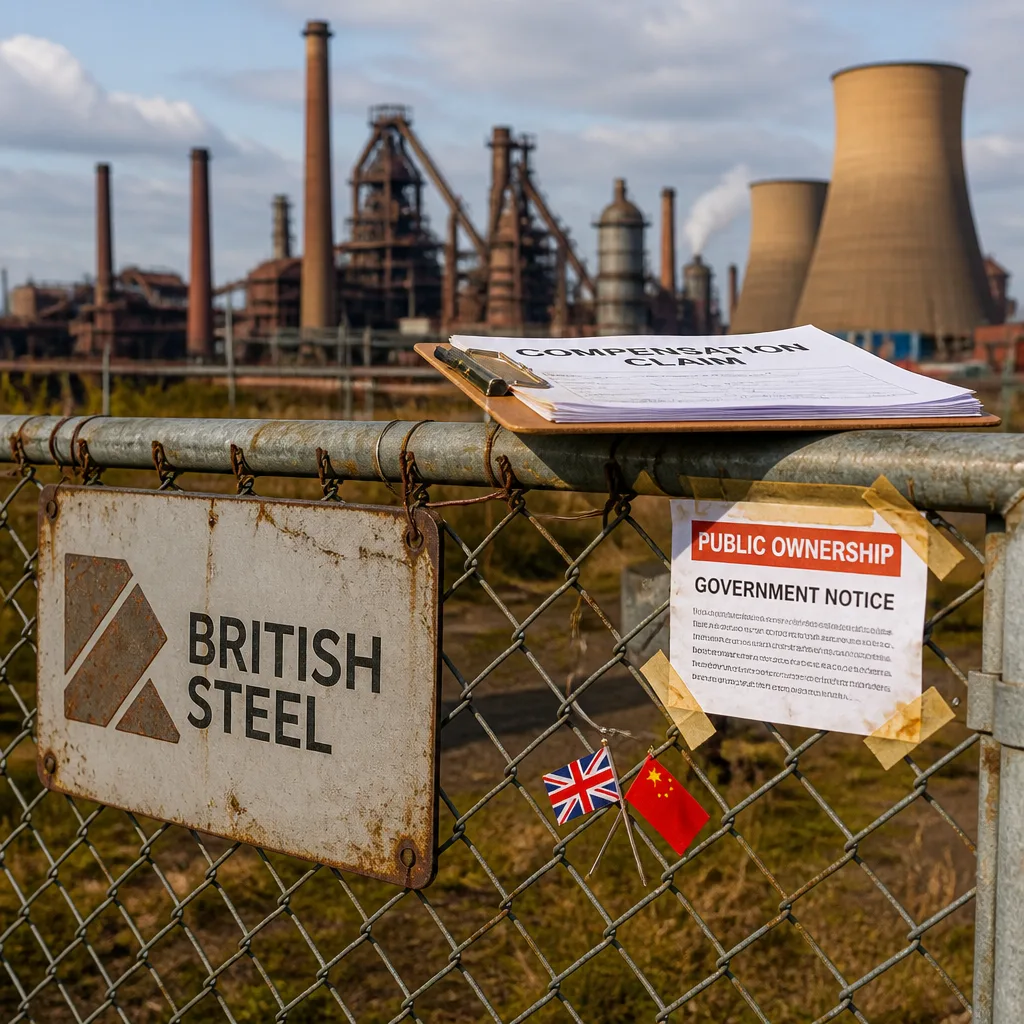
The former owner of British Steel has vowed to pursue the UK government for compensation after ministers brought the Scunthorpe steelworks fully into public hands, intensifying a high‑stakes dispute that touches taxpayers, suppliers and the wider climate for Chinese investment in Britain.
China’s Jingye Group, which acquired the Lincolnshire site in 2020, said it would challenge the move after the plant was taken into complete public ownership on Thursday, following a year in which the government had exercised operational control. The company had previously warned the plant was not viable, citing losses of about £700,000 a day and launching a consultation on closure in March last year.
Jingye said it would seek "full compensation through legal means to the very end" in response to the UK’s decision.
Ministers argue the step was necessary to protect a “vital national capability”, with formal ownership now enabling the state to decide the plant’s future directly. A government spokesperson said draft regulations to establish a compensation pathway would be published in the autumn, setting out a process where an independent assessor determines “what, if any, is payable” after failed commercial talks with the Chinese group to reach a deal that offered “value to the taxpayer”.
Diplomatic and investment fallout
Beijing has condemned the nationalisation, signalling a potential chill in bilateral business sentiment at a sensitive political moment as a new prime minister prepares to enter Downing Street on Monday. China’s commerce ministry said the move “seriously infringed” Jingye’s interests and “severely undermined the confidence of Chinese companies investing in the UK”, adding it would support Chinese firms in defending their rights.
China said it "firmly opposes and is strongly dissatisfied" with the decision.
For multinational investors, the dispute underscores political risk around strategic assets. While national security and industrial resilience are increasingly shaping policy across advanced economies, prolonged legal wrangling could weigh on perceptions of the UK as a predictable destination for long‑term capital, particularly from China‑based groups.
What this means for businesses and households
- Continuity for supply chains: Full public ownership gives the government levers to keep production running, supporting domestic customers that rely on long products and related steel inputs.
- Taxpayer exposure: Any eventual compensation award would fall on the public purse; ministers have flagged an independent assessment and no presumption of payment.
- Market dynamics: Clearer control could accelerate decisions on investment, restructuring or partnerships, with potential effects on prices and reliability for construction and manufacturing buyers.
How we got here: key milestones
| Year/Date | Event |
|---|---|
| 2020 | Jingye completes purchase of British Steel’s Scunthorpe plant. |
| March 2025 | Jingye begins consultation on closure, citing heavy losses of ~£700,000/day. |
| April 2025 | UK government assumes control of operations while ownership remains with Jingye. |
| Thursday (2026) | State moves to full nationalisation to secure a “vital national capability”. |
| Autumn (planned) | Draft regulations to outline the compensation assessment process. |
Next steps and open questions
The clash now turns on valuation and process. The government intends to codify a route for claims, with an external assessor to decide whether any payment is due. Jingye has signalled an uncompromising legal stance. The outcome will shape the final cost to the Exchequer and set a precedent for future interventions in strategically sensitive sectors.
For the workforce and local suppliers, continuity of ownership brings near‑term certainty over operational decision‑making. Beyond that, the state must decide on the steelworks’ longer‑term model — whether via restructuring, fresh investment, partnership or eventual return to private ownership — to stabilise output and support downstream industries. Clarity on that path will be closely watched by contractors, logistics providers and energy and materials vendors whose revenues depend on the plant’s run‑rate.
Relations with Beijing are also in focus. Even without explicit retaliatory steps, the strong language from China’s commerce ministry, combined with the visible collapse of negotiations between ministers and Jingye, raises the prospect of more cautious Chinese capital in UK assets. For British firms seeking equity or customers in China, the diplomatic temperature matters for deal flow and financing costs.
In practical terms, customers purchasing steel for construction and manufacturing will look for predictable volumes and timelines. If nationalisation brings quicker decisions on maintenance, investment and scheduling, buyers could benefit from fewer disruptions. Conversely, if legal uncertainty drags on and clouds planning, procurement managers may hedge with alternative sources, affecting margins across the domestic steel value chain.
The government’s promised framework in the autumn will be a crucial marker. It must balance three competing aims: safeguarding industrial capability; protecting taxpayers from unnecessary liabilities; and signalling that the UK remains open to investment — with clear rules — in its most strategic industries.