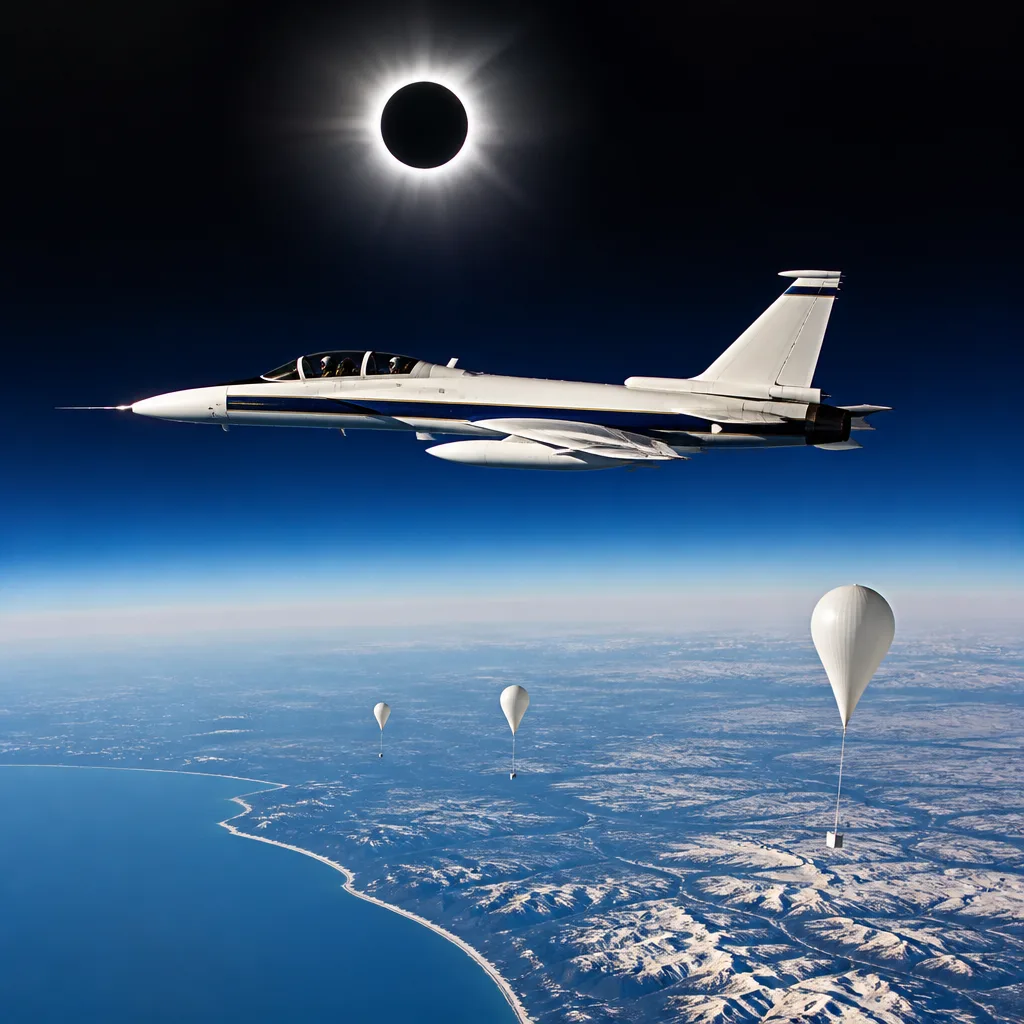
NASA is mounting a coordinated observational campaign for the total solar eclipse on 12 August, when the Moon's shadow will sweep over Greenland, Iceland and Spain. Teams funded by the agency will fly a high-altitude research aircraft and launch scientific balloons to capture rapid, high-resolution imagery of the Sun's outer atmosphere — the corona — and to measure how the sudden darkening alters Earth’s atmosphere.
High-flying imagery of the corona
Central to the campaign is one of NASA's WB-57 high-altitude jets, which will carry a suite of four cameras developed by the NASA Scientifically Calibrated In-Flight Imagery (SCIFLI) team at Langley Research Center. The cameras, installed in the aircraft's nose cone, are designed to record the corona and solar prominences in several wavelengths of visible and infrared light.
The instrument package will capture at least 20 images per second, allowing scientists to document structures, outflows and rapid changes in the corona during totality. Flying up to 50,000 feet gives the platform a stable, above-weather vantage point that complements ground-based observations and balloon-borne sensors.
Balloon-borne atmospheric studies
Alongside the WB-57 flight, teams will launch scientific balloons to probe how the abrupt loss of sunlight during the eclipse affects atmospheric properties. The write-up notes previous student balloon activity during the 8 April 2024 eclipse — a University of Kentucky student team launched a balloon from Bloomington, Indiana — indicating the programme includes educational and training elements as well as research.
"From our unique perspective on Earth during a total solar eclipse, scientists can study the sun's corona in a way we can't from anywhere else in the solar system," said Kelly Korreck, eclipse programme manager at NASA Headquarters in Washington.
Why this matters
Observing the corona during totality offers insights into solar dynamics that are difficult to obtain otherwise. The corona drives space weather that can affect satellites, astronauts and terrestrial systems; resolving rapid changes and outflows improves understanding of the physical processes at play. The multi-platform approach — aircraft, balloons and ground teams — increases temporal and spectral coverage of the event.
- Instrument: four-camera suite in WB-57 nose cone (SCIFLI, Langley)
- Imaging rate: ≥ 20 frames per second
- Flight altitude: up to 50,000 ft
- Geography: eclipse path across Greenland, Iceland and Spain
The campaign builds on earlier eclipse work: imagery from the same camera suite was used during the 8 April 2024 total solar eclipse. By combining aircraft-based, balloon and ground observations, researchers expect to capture both rapid coronal dynamics and concurrent atmospheric responses to the instantaneous loss of solar irradiance.
| Platform | Capability | Role |
|---|---|---|
| WB-57 jet | Up to 50,000 ft; 4 cameras; ≥20 fps | High-resolution multi-wavelength corona imaging |
| Scientific balloons | Atmospheric sensors | Measure atmospheric response during eclipse |
This preparatory and operational work underscores the value of eclipses as natural experiments. The temporary darkening gives scientists a brief, otherwise unattainable view of the corona and an opportunity to study transient coupling between solar and atmospheric processes. Results from the campaign will inform models of solar behaviour and space-weather forecasting, while offering training opportunities for student teams involved in balloon launches.