Researchers co-led by the UCLA Samueli School of Engineering and South Korea’s Ewha Womans University have reported a chemical process that converts unsorted consumer plastics directly into high-purity hydrogen fuel while capturing and immobilising most of the plastics’ carbon.
How the process works
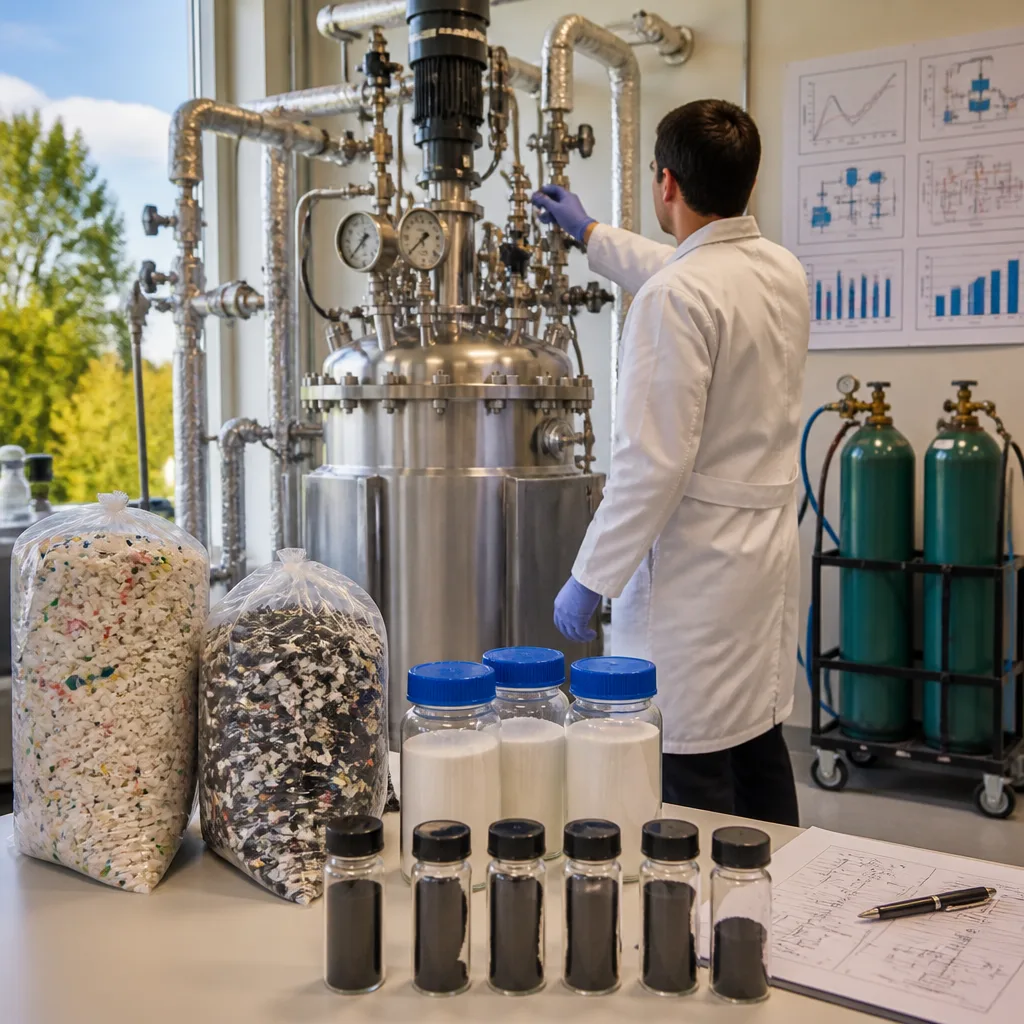
The team adapted an Alkaline Thermal Treatment (ATT) in which a sodium hydroxide reagent reacts with mixed plastics — specifically the three most common consumer polymers: PET (polyethylene terephthalate), PE (polyethylene) and PP (polypropylene) — within a single reactor. The chemistry produces hydrogen gas and yields solid and liquid carbon-containing products instead of emitting CO2 to atmosphere.
- Single-reactor handling of mixed, unsorted plastics removes the need for costly separation by polymer type.
- Built-in carbon trapping: the sodium hydroxide converts over 75% of the plastics’ carbon into stable solid carbonates or liquid residues, effectively sequestering that carbon.
- The method operates at temperatures reported to be 300–400°C lower than typical steam gasification routes, reducing energy demand for the conversion step.
Implications and limitations
If scalable, the approach could address two entrenched problems: the low recycling rates of mixed plastic waste and the need for low-carbon hydrogen. By tolerating unsorted PET, PE and PP — materials that dominate household plastic — the process sidesteps the logistical and economic burdens of mechanical sorting that hamper many recycling systems.
Crucially, the reaction’s use of sodium hydroxide means much of the plastic carbon is retained in solid or liquid products, which the researchers suggest can be further processed into stable minerals such as calcium carbonate to provide permanent carbon storage. That contrasts with conventional incineration or standard gasification, which release CO2.
| Plastic type | Abbreviation |
|---|---|
| Polyethylene terephthalate | PET |
| Polyethylene | PE |
| Polypropylene | PP |
However, the report notes process conditions, reagent use and the fate of the carbon-bearing residues as key technical and economic questions. The need for sodium hydroxide and the handling or further processing of the solid/liquid carbonates will influence lifecycle emissions, costs and the environmental profile of any commercial deployment.
Context for UK and international policy
The development arrives as governments pursue both hydrogen supply and circular-economy goals. Hydrogen made from waste plastics could supplement low-carbon hydrogen produced from renewables or from electrolysis using low-carbon electricity, and might provide a route for diverting material from landfill and incineration.
Adoption would hinge on independent lifecycle assessments comparing this ATT route with established waste-management and hydrogen-production options, regulatory acceptance of the residues as permanently sequestered carbon, and the economics of reagent supply and product separation. Demonstration at larger scales will be required to test whether the laboratory or pilot findings translate to municipal waste streams and industrial realities.
The research demonstrates a promising intersection of waste management and fuel generation, but real-world impact will depend on further technical validation, cost analysis and regulatory scrutiny.