The Sloan Digital Sky Survey's latest public data release (DR20) has made available a new set of spectral maps from the Local Volume Mapper (LVM), offering astronomers a far more detailed picture of the gas that threads the Milky Way and nearby galaxies. The release — the 20th in the SDSS series — provides observations that let researchers measure the chemical composition, temperature and kinematics of interstellar gas in regions where stars form and die.
What the LVM adds to sky surveys
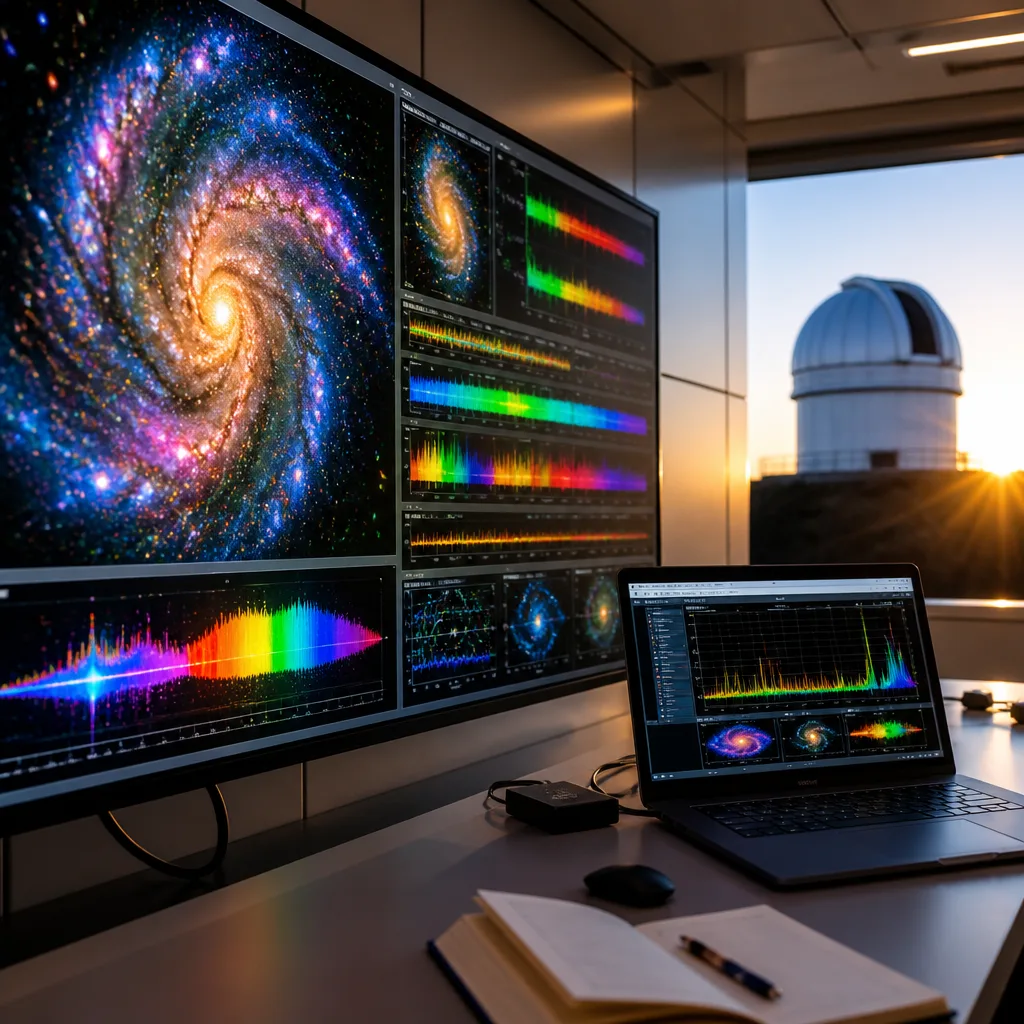
Unlike conventional astronomical images, which capture broad bands of light, the LVM splits incoming light into thousands of individual wavelengths. That spectral information allows scientists to infer physical conditions in nebulae and other diffuse structures that ordinary photographs cannot resolve. The survey began collecting data in 2023 and the new products were included in DR20, published alongside tools intended to make the dataset widely accessible.
UK‑relevant contributions and tools
Researchers from NYU Abu Dhabi are named among the contributors to the collaboration. Work described in the release includes the processing and calibration of the LVM measurements and the development of an online visualisation platform, LVMvis. The web tool was released with DR20 and enables scientists, students and members of the public to explore the observations directly through a web browser without bespoke software.
"Modern astronomy produces enormous amounts of data, and making that data easy to explore and visualise is just as important as collecting it,"
The quote accompanies the description of LVMvis's goals: to help researchers interrogate survey observations and to allow a broader audience to examine what the instruments have recorded.
Scientific implications
The spectral maps support investigations into how stars form, how young and dying stars interact with surrounding gas, and how these processes drive the large‑scale evolution of galaxies. Making the dataset public is intended to accelerate work across the astronomy community by removing barriers to access and enabling reuse of calibrated observations for multiple analyses.
- Survey: Local Volume Mapper (part of SDSS‑V)
- Data release: SDSS DR20 (20th public release)
- Data collection began: 2023
- Tools: LVMvis interactive web visualiser
| Item | Detail |
|---|---|
| Programme | SDSS‑V, Local Volume Mapper |
| Public release | DR20 |
| Data collection start | 2023 |
Open spectral surveys such as the LVM can change the speed and direction of research by providing standardised calibrated observations that multiple groups can analyse independently. The combination of high spectral resolution across extended spatial regions and an easy web interface lowers the technical threshold for new users to engage with modern survey data.
Researchers and educators in the UK and internationally can now access these calibrated maps and the LVMvis platform to inspect nebulae and galaxy environments, quantify gas properties and build comparative studies that probe star formation, feedback processes and galactic structure.
As the SDSS family of surveys has shown over two decades, wide public releases coupled with user‑friendly tools tend to broaden participation and reuse — from specialist research to classroom and citizen‑science projects. DR20 and the LVM deliver both new measurements and infrastructure intended to make those measurements useful to a wider audience.