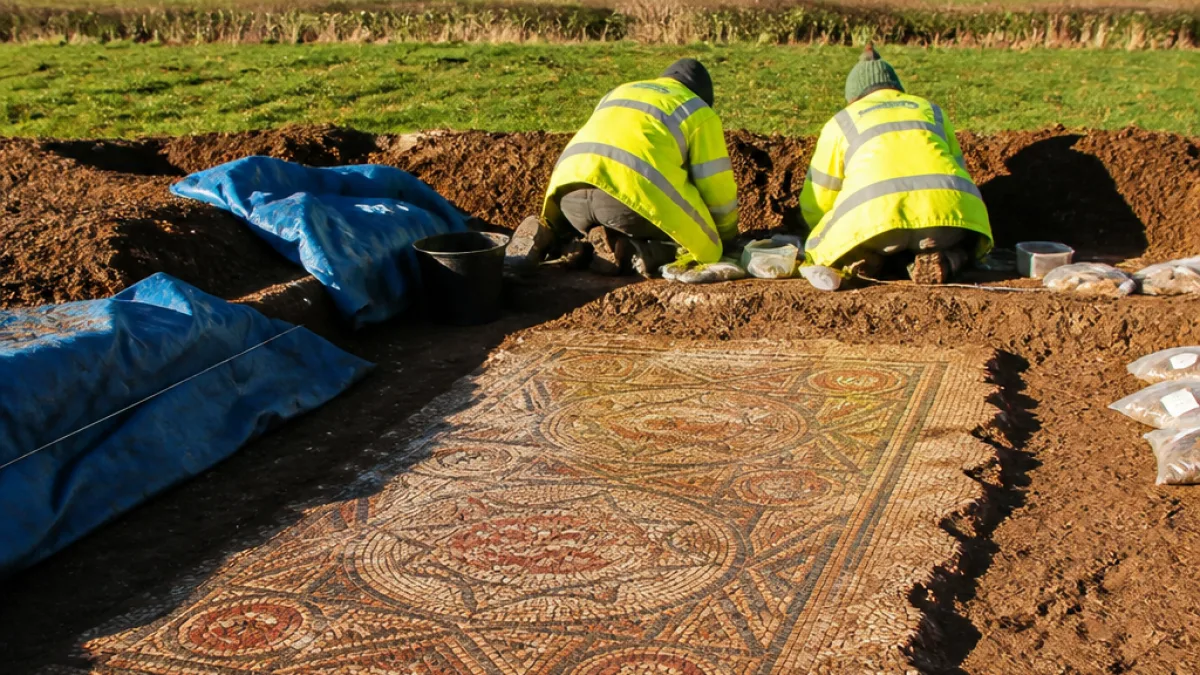
Teams from the University of Exeter and Cotswold Archaeology have uncovered a polychrome Roman mosaic while excavating the remains of a villa on farmland between the villages of Halberton and Sampford Peverell in Mid‑Devon. The decorative floor, constructed from minute 12mm stone cubes, features a central stylised flower with eight overlapping teardrop petals and interlaced knotted lines — a pattern recognised in Roman decorative schemes.
Context and significance
The work forms part of the Saving Halberton's Ancient Roman Environment (SHARE) project, which began after Roman traces were first reported by local metal detectorist John Hill in 2004. Excavations have already revealed substantial features, including a bathhouse with at least two plunge pools, indicating occupants of considerable means.
“At the outset, we knew this villa, and its surrounding working areas, was an important site for understanding the ‘Romanisation’ of Devon. But from day one, it has offered us a wealth of interesting and sometimes surprising finds in addition to this striking polychrome mosaic,”
Project lead Dr Susan Greaney of the University of Exeter’s Department of Archaeology and History said the villa was likely home to people of wealth and status. Bill Horner, Devon County Council's county archaeologist and historic environment manager, described the mosaic as the most westerly example of a polychrome mosaic found in a villa in Roman Britain.
What was found and next steps
The mosaic is composed of thousands of tiny red, white and dark blue tesserae. Specialists are now carefully lifting the pavement so it can be conserved and placed on public display at Tiverton Museum of Mid‑Devon Life, alongside other artefacts recovered during the dig.
- Discovery: polychrome mosaic with floral and interlaced knot motifs
- Associated features: bathhouse with multiple plunge pools, other villa remains
- Project: SHARE, led by University of Exeter and Cotswold Archaeology
- Planned destination: Tiverton Museum of Mid‑Devon Life
The team emphasise the care being taken to record and lift the mosaic so the public can see it while preserving the material for long‑term study.
Local and scholarly impact
Finds such as this have direct bearing on how archaeologists understand Roman influence in the far western provinces of Britain. The combination of a decorative mosaic and a substantial bathing suite suggests a residence aligned with Roman domestic culture and comforts, adding nuance to the picture of rural Devon in the fourth century AD.
| Item | Detail |
|---|---|
| Location | Farmland between Halberton and Sampford Peverell, Mid‑Devon |
| Period | Fourth century AD (Roman Britain) |
| Project | Saving Halberton's Ancient Roman Environment (SHARE) |
Local museums and heritage officers will now coordinate conservation and display plans. For residents and visitors, the forthcoming exhibition at Tiverton Museum will provide the first opportunity to view material from the excavation and learn more about the lives of the villa's occupants.
The discovery adds to a string of substantial Romano‑British finds in the county and will inform future research into settlement, economy and cultural exchange in Devon during the later Roman period.