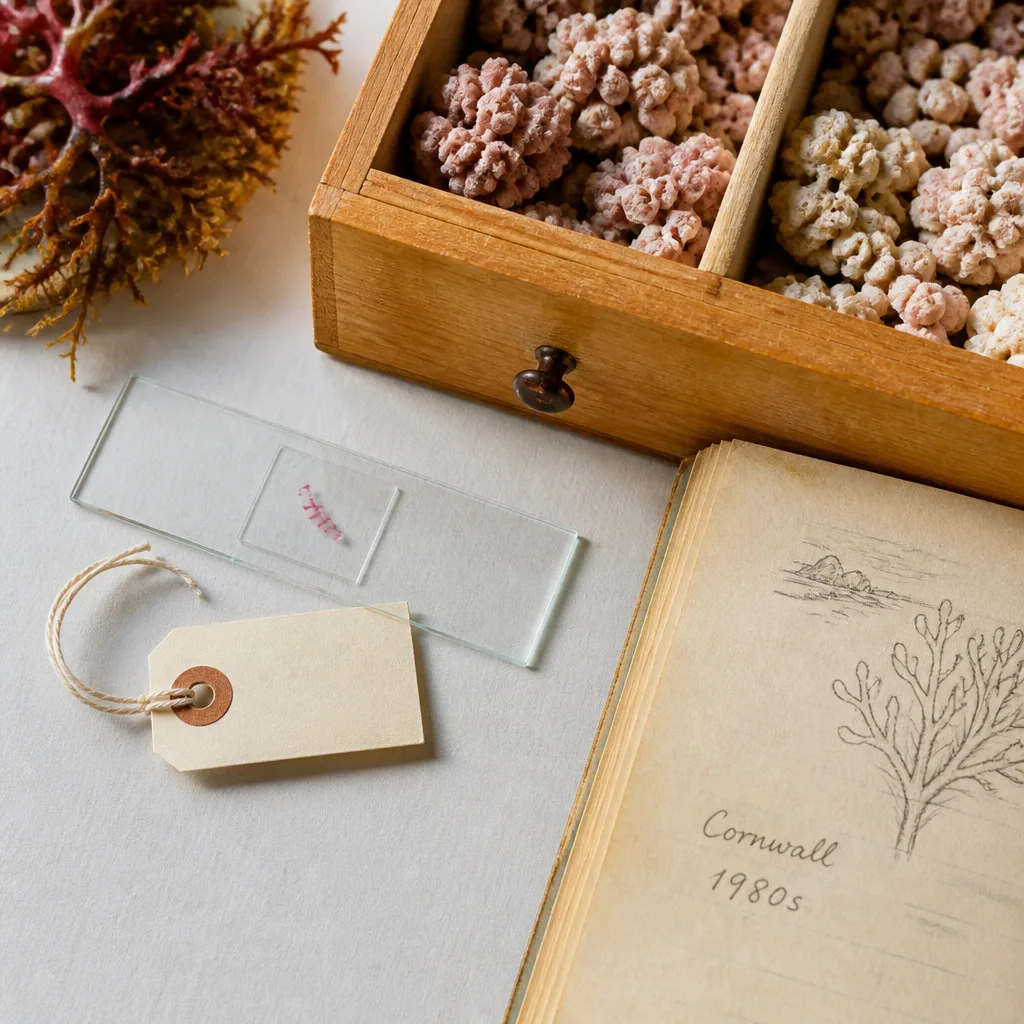
Researchers have confirmed that a diminutive, pink-striped seaweed collected from British maerl beds represents a species previously unknown to science. The finding closes a search that began during a PhD field project and persisted across decades of study.
From a fragment to formal recognition
In the 1980s, while undertaking doctoral research, Professor Christine Maggs came across a small fragment of a pink seaweed living among maerl — the calcified, free-living seaweeds that form carpet-like beds and support high biodiversity in UK coastal waters. She suspected the organism was undescribed, but the sample was too small to allow a formal identification.
Over the ensuing years the tiny alga made fleeting appearances in Prof Maggs’s records, once observed living on a sea squirt, yet no larger specimen came to light. The breakthrough arrived when a team surveying the health of Cornish maerl beds, working as part of a project organised by Natural England, recovered material that matched her long-held notes.
"I just kept hoping that I would find out, it's been over four decades,"
Anticipating the tests required to establish the seaweed’s status, Prof Maggs purchased a wine fridge to provide a suitable cool, dark storage environment for the delicate sample. Following analysis, the species has been accessioned into the collection of the Natural History Museum, where pressed specimens join the national archive of seaweeds.
Why maerl beds matter
Maerl beds, though superficially resembling coral, are made of thousands of interlocking pieces of calcified algae. These structures create complex habitats that support a wide range of marine life. The newly described seaweed was discovered living on these beds in the Fal estuary and other Cornish locations surveyed.
- Habitat: Maerl beds in the UK coastal zone
- Initial discovery: Fragment found during PhD research roughly 40 years ago
- Recent recovery: Matching specimen located by Cornish maerl survey work two years ago
- Repository: Sample now part of the Natural History Museum’s collection
Timeline of the discovery
| Event | Approximate timing |
|---|---|
| First fragment recorded during PhD | ~40 years ago |
| Fleeting subsequent observations (including on a sea squirt) | Intervening decades |
| Matching specimen found in Cornish maerl survey | 2 years ago |
| Specimen added to Natural History Museum collection | Recent |
The formal recognition of this tiny seaweed as a distinct species has immediate value for biodiversity records and for ongoing monitoring of maerl bed health. Curated specimens in museum collections provide a permanent reference for future taxonomic, ecological and conservation work.
While the new species is small, the story underlines how much remains to be documented even in well-studied national habitats, and how long-term attention and targeted surveys can yield scientifically significant discoveries.