Archaeologists working on farmland between Halberton and Sampford Peverell have uncovered the remains of a substantial Roman villa complex, including a finely tessellated mosaic and a sizeable bathhouse, in a discovery that expands understanding of affluent occupation in late Roman Devon.
What the dig revealed
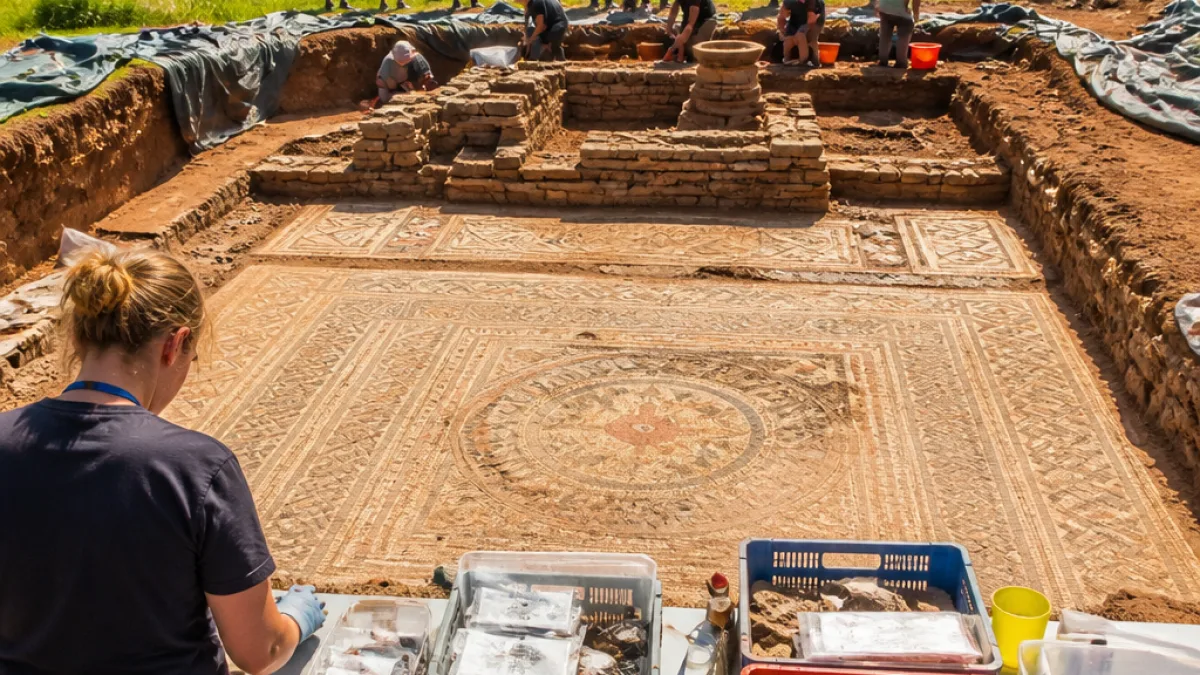
Field teams from the University of Exeter and Cotswold Archaeology, assisted by community volunteers, carried out a two-month excavation that brought to light a 129-square-foot mosaic composed of thousands of red, white and dark blue-grey tesserae. The central motif is a circular design formed of eight overlapping teardrop-shaped petals.
"This villa was undoubtedly home to people of wealth and high standing," said project lead Dr Susan Greaney.
Alongside the mosaic, archaeologists identified a separate bathhouse with painted-plaster walls and at least two plunge pools, indicators of domestic comfort and status rather than basic utility. Finds from the site also included pottery sherds, a copper-alloy bangle, a silver-plated spoon and a blue glass intaglio used to seal wax documents, one depicting the goddess Victory.
Significance for Devon's Roman archaeology
County Archaeologist Bill Horner described the mosaic as the westernmost example of a polychrome villa floor yet found in Roman Britain, underlining the importance of the find for regional archaeology. Such features are relatively rare in this part of the country and point to a degree of wealth and connectivity not always assumed for rural Devon during the 4th century A.D.
- Site location: farmland between Halberton and Sampford Peverell
- Principal finds: 129 sq ft polychrome mosaic, bathhouse with plunge pools
- Associated artefacts: pottery, bangle, silver-plated spoon, blue glass intaglio
- Dating: 4th century A.D.
Conservation and public access
Specialists are currently undertaking careful lifting and stabilisation of the mosaic so its colours and patterning are preserved. Once conservation work has been completed, the mosaic is expected to be displayed at Tiverton Museum of Mid-Devon Life, allowing local residents and visitors to view a piece of their Roman past.
| Feature | Notes |
|---|---|
| Mosaic | 129 sq ft; polychrome tesserae; central floral motif |
| Bathhouse | Painted plaster; at least two plunge pools |
This discovery contributes to a growing picture of Roman-era settlement across Devon, showing that what is now quiet agricultural landscape once supported estates equipped with luxury amenities. The involvement of local volunteers in the excavation also emphasises the community dimension of uncovering and preserving regional heritage.
Further details, including timings for public display at Tiverton Museum, will be released once conservation is complete. In the meantime, finds are being recorded and stabilised for study and long-term preservation.